
Understanding the challenges in roofing scheduling
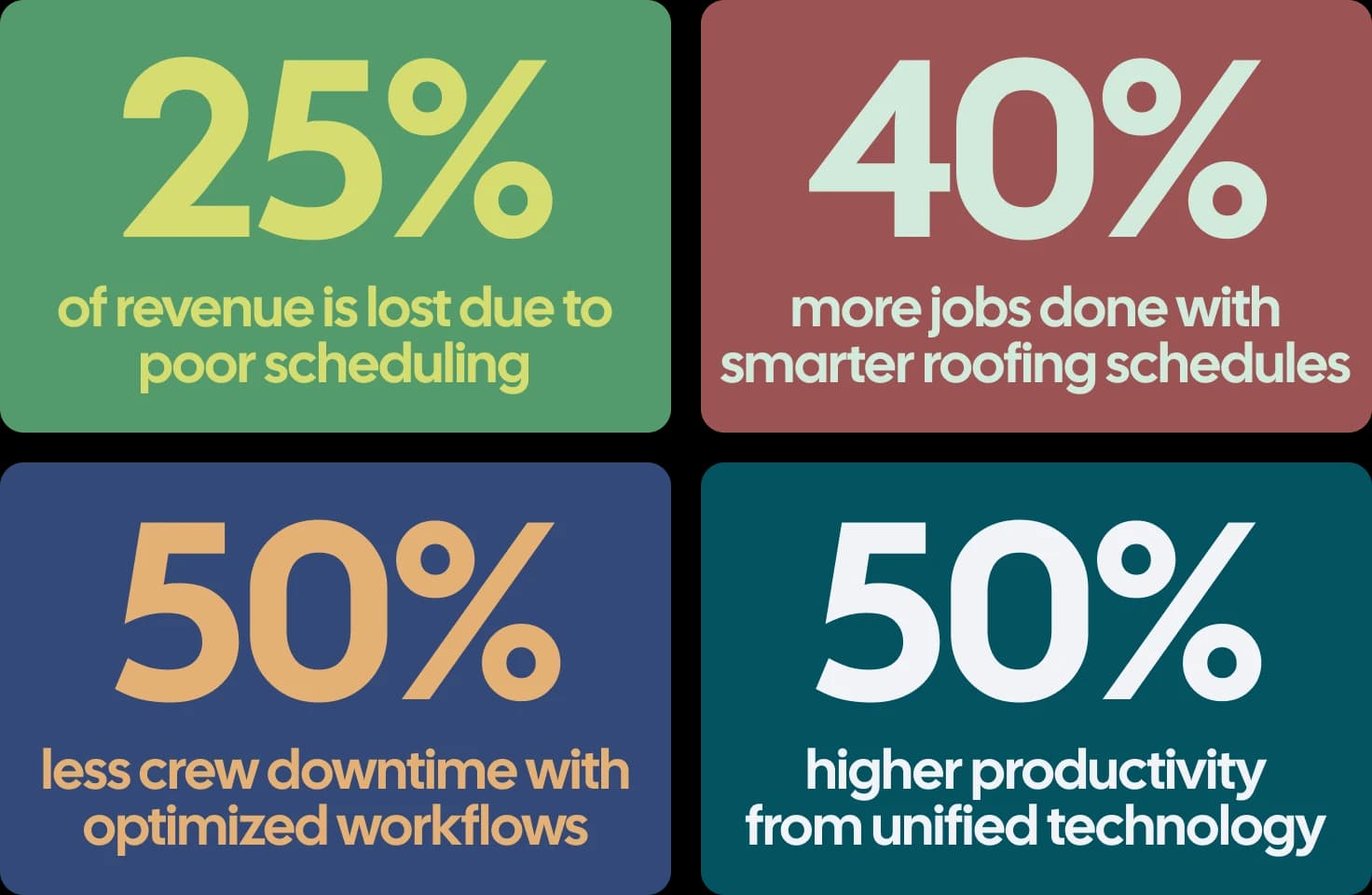
The roofing industry is uniquely demanding. Jobs are weather-dependent, labor-intensive, and often unpredictable. Traditional scheduling methods—relying on spreadsheets, phone calls, and gut feelings—lead to inefficiencies like idle crews, missed opportunities, and frustrated clients. According to a 2023 report from the National Roofing Contractors Association (NRCA), average roofing companies lose up to 25% of potential revenue due to poor scheduling alone.
Common pain points
Weather variability: Sudden rain can derail a week's worth of plans, leaving crews unproductive.
Crew utilization: Without precise roofing crew optimization, workers spend more time traveling than roofing.
Client expectations: Delays erode trust, leading to lost referrals in a word-of-mouth-driven market.
Resource allocation: Materials and equipment often sit idle, tying up capital.
Top companies overcome these by adopting a data-driven approach to roofing productivity tips. They treat scheduling as a science, not an art, integrating forecasts, GPS tracking, and automation to predict and prevent disruptions.
The 40% efficiency benchmark
Industry benchmarks show that elite roofing firms achieve 40% higher job throughput by focusing on three pillars: predictive planning, real-time adjustments, and team empowerment. This isn't about working harder; it's about working smarter to maximize every hour.
Metric | Average company | Top performer | Improvement potential |
|---|---|---|---|
Jobs per crew per week | 2-3 | 4-5 | 40%+ |
Crew idle time | 20-30% | <10% | Reduce by 50% |
Revenue per employee | $150K/year | $210K/year | 40% Growth |
For further reading on industry stats, check the Roofing Contractor Magazine's annual efficiency survey.

Proven strategies for scheduling more roofing jobs
To schedule more roofing jobs without expanding your team, top roofing companies implement layered strategies that build on each other. These focus on foresight, flexibility, and feedback loops to ensure seamless roofing job management.
1. Implement predictive scheduling
Predictive scheduling uses historical data, weather APIs, and AI to forecast optimal job timelines. Instead of reactive planning, companies like those featured in roofing business growth case studies plan months ahead.
Weather integration: Tools like WeatherAPI pull real-time forecasts to slot indoor prep work during rainy spells.
Job batching: Group similar jobs (e.g., shingle replacements) by geography to cut travel time by 30%.
Seasonal buffering: Build in 10-15% buffer time for peak seasons, preventing burnout.
Result? Crews stay busy 90% of the time, directly contributing to that 40% uptick in jobs.
2. Optimize route and resource planning
Roofing crew optimization starts with logistics. GPS-enabled software maps efficient routes, ensuring crews hit multiple sites daily without overlap.
Assess daily capacity: Calculate travel, setup, and execution times per job type.
Use clustering algorithms to assign jobs within a 20-mile radius.
Track fuel and vehicle maintenance to minimize downtime.
For route optimization tools, explore Route4Me's roofing-specific solutions, which have helped users reduce mileage by 25%. Workiz also includes a route builder attached to the tech daily calendar that auto-updates as job are being added to you business management panel. Learn more about Workiz Automations.
3. Foster cross-training and skill versatility
Versatile crews handle diverse tasks, from inspections to repairs, without waiting for specialists. Top firms invest in ongoing training, certifying workers in multiple areas like metal roofing and solar installations.
Weekly skill drills: Rotate roles to build redundancy.
Certification incentives: Boost morale and capability with bonuses for new quals.
Hybrid job packaging: Combine small repairs with larger installs for fuller days.
This approach not only schedules more jobs but enhances roofing productivity tips by reducing bottlenecks.
Workflow optimizations for roofing crew optimization
Beyond tools, it's about refining processes. Top companies redesign workflows to eliminate waste, drawing from lean manufacturing principles adapted for construction.
Standardizing job processes
Create templated workflows for common jobs: inspections, repairs, full replacements. This ensures consistency and speeds up execution.
Pre-job checklists: Verify materials and permits 24 hours prior.
Daily huddles: 10-minute stand-ups to align on priorities.
Post-job reviews: Capture lessons to refine future schedules.
Standardization alone can boost roofing productivity tips by 15-20%, as crews move faster through familiar steps.
Leveraging subcontractors strategically
Without hiring full-time, partner with vetted subs for overflow. Use platforms like Angi Pro to find reliable specialists, maintaining quality while scaling volume.
Clear contracts: Define scopes to avoid disputes.
Performance tracking: Rate subs on time and quality for repeat business.
Hybrid crews: Mix core team with subs for peak loads.
Client onboarding and communication
Efficient scheduling extends to clients. Automated emails and portals keep them informed, reducing inquiries and enabling self-scheduling for small jobs.

Case studies: Real-world success in roofing business growth
Let's look at how these strategies play out. These anonymized examples from top firms illustrate the 40% job increase in action.
Names are different, the experiences are genuine.
Case study 1: Midwest Roofing Inc.
A 20-crew operation in Ohio struggled with seasonal slumps. By adopting Jobber for predictive scheduling and cross-training, they batched jobs geographically and integrated weather data. Result: Jobs per week rose from 35 to 50—a 43% jump—without new hires. Revenue grew 35% in year one.
Key takeaway: Data-driven planning turned weather from foe to ally.
Case study 2: Coastal Elite Roofers
Facing hurricane-prone delays in Florida, this firm used AccuLynx for real-time tracking and AR estimates. They optimized routes via GPS, reducing travel by 28%. Crew versatility allowed handling repairs alongside installs. Outcome: 40% more jobs scheduled, with 15% profit margin improvement.
Before: 60% utilization rate.
After: 92% utilization, minimal idle time.
Industry-wide insights
A study by the Associated General Contractors of America (AGC) highlights that firms using integrated tech see 30-50% efficiency gains. For more cases, read this Roofing Contractor article.
Company | Strategy implemented | Job increase | ROI timeline |
|---|---|---|---|
Midwest Roofing | Predictive Scheduling + Training | 43% | 6 months |
Coastal Elite | Tech Integration + Routing | 40% | 4 months |
Step-by-step implementation guide
Ready to apply these? Follow this roadmap to achieve roofing business efficiency.
Phase 1: Assess current operations (weeks 1-2)
Audit your schedules: Track a month's jobs for idle time, travel, and delays. Use free tools like Google Sheets initially.
Phase 2: Select and integrate tools (weeks 3-4)
Choose one scheduling software based on your size. Pilot with one crew, then scale.
Phase 3: Train and optimize workflows (weeks 5-8)
Conduct workshops on new processes. Monitor KPIs weekly: utilization rate, jobs completed, client satisfaction.
Phase 4: Measure and iterate (Ongoing)
Set quarterly reviews. Adjust based on data—aim for that 40% milestone within six months.
KPIs to track: Jobs per crew, revenue per job, crew hours billed.
Common pitfalls: Resist change; undertrain staff; ignore feedback.
For templates, download free resources from NRCA's efficiency toolkit.