
Key Takeaways
Standardize pricing with a digital flat rate price book to deliver upfront quotes, ensure consistency, and protect margins.
Build flat rate pricing using fully loaded labor, materials, overhead, target margins, and standardized service categories.
Protect profits by including overhead, updating material costs, using the correct margin formula, and charging appropriately for emergency work.
Increase close rates and ticket size with Good/Better/Best proposals, on-the-spot financing, and immediate payment collection.
Transitioning a plumbing business to high-margin growth requires a shift from unpredictable time-and-materials billing to a standard flat rate pricing system. For growing teams with 5 to 50 technicians, relying on field technicians’ billing calculations causes pricing discrepancies and compressed margins.
Here is how to build a clear price book that protects your profit margins and gives your customers total pricing clarity before the work starts.
What Is Plumbing Flat Rate Pricing?
Flat rate pricing means quoting a single, all-inclusive price before the job begins. This model completely replaces the need to tally up hours and materials at the end of a service call. With this, you can bake labor, parts, business overhead, and your target profit margin into one upfront figure.
For growing companies, hourly billing forces clients to watch the clock, questioning technician speed or supply house trips. Moving to a flat rate gives homeowners total price certainty while protecting your business margins from slow field execution and standardizing service delivery across your entire fleet.
Time & Material Pricing vs Flat Rate Pricing
Flat Rate | Time & Material | |
Set Price | Before the Work Begins | After the work is complete |
Disputes About Hours | None | Common |
Margin Impact | Rewards efficient work | Penalizes fast plumbers |
Best For | Routine service call | Unknown scope of work |
Why Plumbing Flat Rate Pricing Matters
Moving away from tracking hours cuts out constant billing cleanups and ensures you know exactly how much money is coming in on every single job.
Consistent Prices Across Every Tech and Job: A standard price book ensures every technician quotes the exact same rate for the exact same job. It stops pricing guesswork, builds customer trust, and makes back-office auditing quick and easy.
Faster Quote Approvals and Less Negotiation: Handing over a guaranteed upfront price takes the billing anxiety out of the driveway. Homeowners get immediate clarity, meaning your techs win fast signatures and skip stressful debates over hourly rates.
Healthier Margins with Every Completed Job: Flat-rate billing rewards speed and efficiency. When your top-tier technicians finish a job fast, your business makes more money per hour, completely reversing the old hourly system that penalizes fast work.
Between 2021 and 2025, the plumbing material costs have jumped roughly 30%. With prices shifting so quickly, a tiny 5% estimating error on a $10,000 installation instantly wipes out $500 of your profit. Locking your rates into a flat-rate price book takes the guesswork out of bids, protecting your margins before a technician ever starts the job.
Types of Plumbing Flat Rate Pricing
To get your price book running right, group your jobs into clear, straightforward categories. This setup lets your dispatchers and field crews look up accurate numbers instantly on their phones, no matter the scope or urgency of the call.
Pricing Category | Core Focus & Calculation Basis | Strategic Business Impact |
Standard Service & Repair | High-volume, repeatable tasks (clogged drains, toilet rebuilds). Combines average time, parts, labor, and overhead. | Eliminates invoice disputes and guarantees predictable profit margins on daily service calls. |
System Installation | Big-ticket equipment swaps (tankless water heaters, repiping). Includes multi-hour labor, materials, permits, and disposal. | Forms the baseline to present multi-option proposals, directly lifting average ticket sizes. |
Emergency Dispatch | After-hours, weekend, or holiday calls. Adds a premium dispatch fee or 1.5x–3x rate multiplier to the base repair fee. | Offsets high technician overtime wages and premiums, keeping urgent leads highly profitable. |
Recurring preventive checkups (annual heater flushes, proactive leak tests). Sold as a discounted flat-rate visit. | Secures recurring cash flow, fills the schedule during slow shoulder months, and queues replacement leads. |
How to Build a Plumbing Flat Rate Pricing System
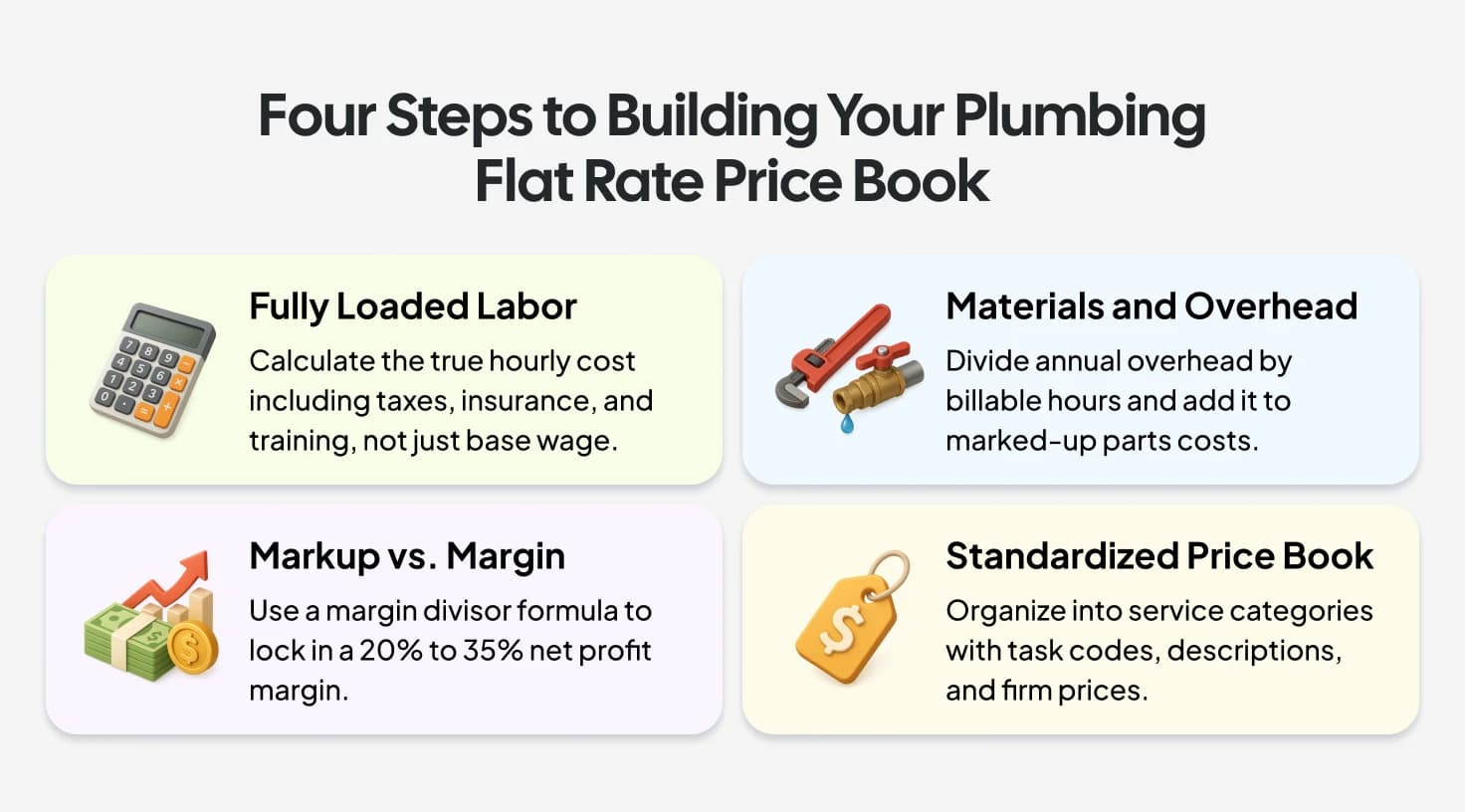
Building a flat rate system isn’t a guessing game based on what the guy down the street charges. It takes some math to protect your cash flow and ensure you actually make money on every ticket. Follow this clear four-step process to get your numbers locked in:
1. Calculate Fully Loaded Labor Costs
Don’t just look at a technician’s base hourly wage. You need to calculate their fully loaded labor cost, which includes payroll taxes, workers’ comp, insurance, uniforms, and training. For example, a $35 base hourly wage can easily cost your business $50 an hour out of pocket.
2. Include Materials, Equipment, and Overhead
Your prices have to pay for your parts and your bills. Add up your annual business overhead, things like office rent, dispatch software, fuel, and truck depreciation, and divide it by your annual billable hours. This gives you an hourly overhead rate to add to your marked-up material costs.
3. Set Markup and Target Profit Margin
Never confuse markup with net profit margin. To lock in a healthy 20% to 35% plumbing profit margin, use a margin divisor formula rather than a simple multiplier. Calculate your final retail rate by taking the sum of your absolute costs, including your labor, parts, and overhead expenses, and dividing that total by one minus your target net profit margin percentage.
4. Organize Into a Standardized Price Book by Service Category
Group your final numbers into clear, searchable categories like drain cleaning or water heaters. Give every job a specific task code, a clear description of the work, standard parts allowed, and a firm price. Make sure every listing aligns with uniform plumbing code standards so your team does compliant work that eliminates free warranty callbacks.
Common Plumbing Flat Rate Pricing Mistakes
Moving to flat rate pricing means you take on the risk if a job runs long. If a tech hits a snag, your business absorbs the extra time, not the customer. That is why getting your numbers exactly right matters so much.
Common Pricing Mistake | Real-World Impact | Corrective Action |
Leaving Out Overhead | Covering parts and wages isn’t enough to pay for rent, software, fuel, and trucks. | Divide annual overhead by billable hours to build a fair share into every book entry. |
Confusing Markup with Margin | Using a simple multiplier directly on your costs leaves your business underfunded. | Use the correct margin divisor formula: Price is equal to total cost divided by one minus target margin. |
Using Outdated Material Costs | Static paper sheets mean supplier price jumps quietly, erasing your profit margins. | Use a digital platform to push real-time material price updates to your field crew. |
Underpricing Emergency Work | Billing daytime rates for midnight calls loses money once you pay overtime wages. | Use a clear after-hours multiplier (1.5x to 3x) or a flat emergency fee ($150 to $350+). |
Managing cash flow remains a massive hurdle for growing trade businesses. Ditching retrospective invoicing for upfront flat rate estimates with on-site payment processing protects your cash flow and stops collection delays before your truck leaves the driveway.
How to Present Flat Rate Prices in the Field
An accurate price book is only half the battle. To hit your growth goals, your field technicians need to know how to present these rates confidently right from the customer's driveway.
Using Tiered Good/Better/Best Proposals
Give clients a choice of three service options:
Good: Basic repair
Better: Repair bundled with preventive maintenance
Best: Full equipment upgrade
Presenting visual choices takes the sales pressure off your technicians while naturally boosting your average ticket size.
Offering Financing to Close High-Ticket Jobs on the Spot
Sudden emergencies like collapsed sewer lines cause instant financial stress for homeowners. Integrating flexible customer financing directly into your mobile proposals lets clients get approved for credit on the spot. This helps your crew close high-ticket service jobs immediately before competitors even have a chance to bid.
Plumbing Flat Rate Pricing Best Practices
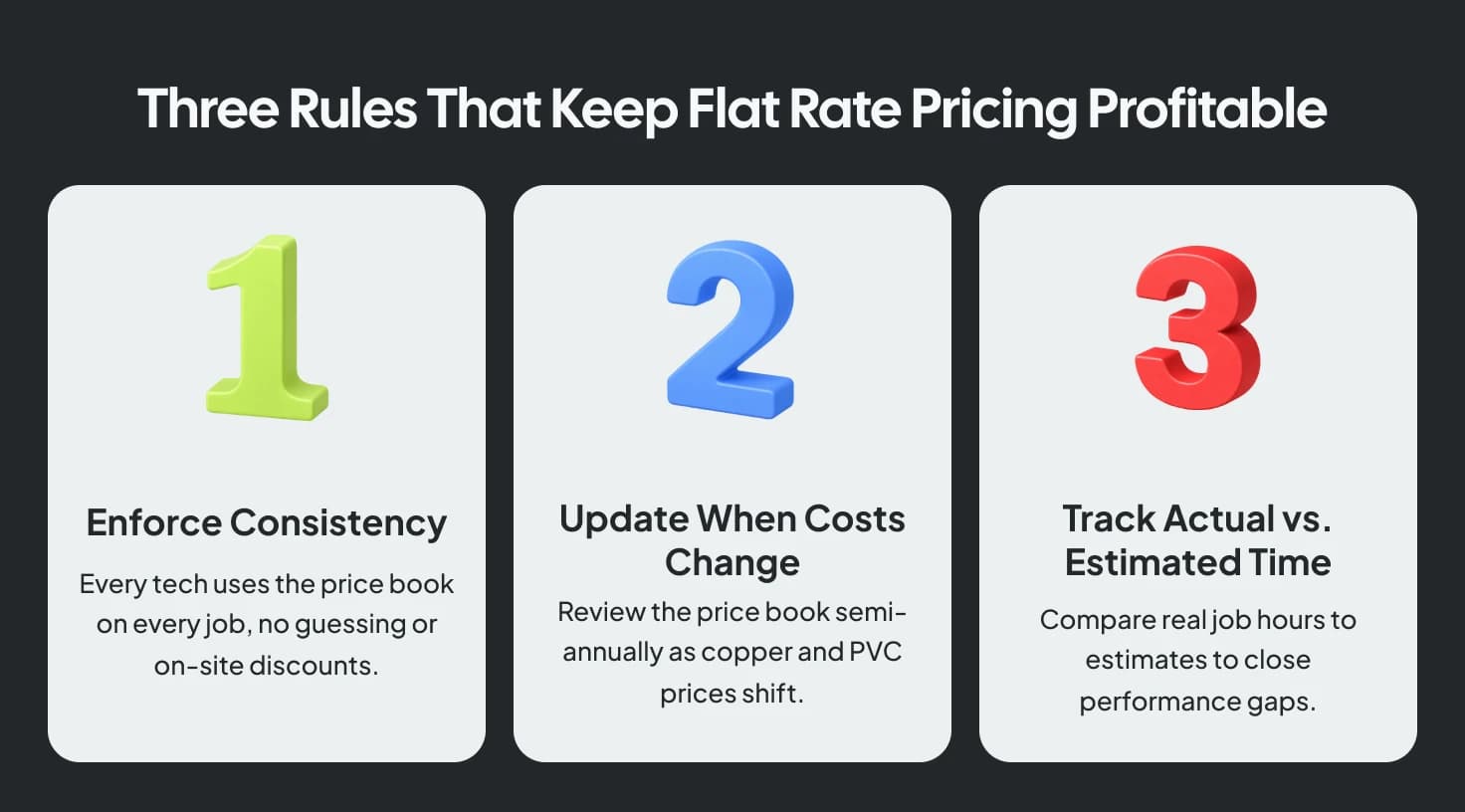
Maintaining a highly profitable operation requires continuous pricing updates and operational discipline. Establish these three core rules across your contracting business to safeguard your cash flow over time:
Keep Pricing Consistent Across the Whole Team: Enforce price book utilization on every job. Allowing field technicians to guess rates or offer arbitrary on-site discounts breaks your system’s consistency and degrades consumer trust.
Update the Price Book When Material Costs Change: With material prices like copper and PVC fluctuating constantly, review your book semi-annually. This prevents your business from absorbing sudden supply chain price jumps and eroding margins.
How Workiz Helps Standardize Plumbing Flat Rate Pricing
Managing a manual price book becomes impossible when scaling a fleet of 5 to 50 technicians. Workiz provides an all-in-one field service platform built for the trades, giving you the tools to lock in your rates and protect your profit margins.
Build and Present Flat Rate Estimates from the Mobile App
Right from the customer driveway, your technicians can pull up your digital price book, find fixed service codes, and build accurate flat rate estimates in seconds. This eliminates math errors and cuts out frustrating phone loops with the office.
Good/Better/Best Proposals That Lift Average Ticket Size
The built-in estimating software lets techs present clear, tiered choices right on a tablet or smartphone. Your crew can bundle services, attach job photos, and offer instant on-site financing via Wisetack. This transparent layout takes the sales pressure off your techs while naturally boosting average job values.
Workiz Pay Collects Payment the Moment the Job Closes
Ditch the delays of mailing invoices and waiting on paper checks. With Workiz Pay, technicians can take secure credit card or cardless mobile payments right on-site. This fast closeout gets cash into your bank account the next business day instead of waiting weeks to collect.
QuickBooks Sync Keeps Job Costs and Invoicing Aligned
Workiz features a native QuickBooks integration that automatically maps closed invoices and payments to your accounting system. This removes double-entry headaches and gives you clean, real-time visibility into your actual job costs.
High-performing shops pair their flat rate pricing with Genius Scheduling to reduce manual dispatch work and keep trucks running efficiently. Plus, you can capture every call with an AI-driven voice assistant behind Genius Answering, which works 24/7 to qualify leads and suggest available appointment times based on your calendar before your competitors even pick up the phone.
Conclusion
Building a highly profitable plumbing business comes down to how you run your operations, not how hard you sell. When your fleet expands to between 5 and 50 technicians, relying on old paper price sheets and guessing rates on-site will quietly destroy your bottom line.
True growth happens when you drop unpredictable hourly billing. By moving to a digital flat rate price book, offering clear tiered choices, and collecting payments right on-site with an all-in-one field service platform like Workiz, you can eliminate daily cash flow uncertainty and scale your business into a dominant regional brand.