
Key Takeaways
HVAC advertising captures high-intent local demand through Google Search Ads, Local Services Ads, social media, referrals, and reviews to drive booked service calls.
Align advertising with operations by targeting the right service areas, setting channel budgets, using dedicated landing pages, and optimizing your Google Business Profile.
Measure success with revenue-focused metrics like cost per lead (CPL), call-to-booking conversion rate, and revenue per ad source instead of lead volume.
Use seasonal campaigns, high-intent keywords, and ongoing ad and landing page testing to improve conversions and technician utilization.
In the HVAC business, lead intent is everything. When a homeowner needs an emergency repair, they call the first company that answers. If you're spending thousands on Google Ads, but your dispatch process is tied to manual spreadsheets, you're just paying to feed your competitors.
Protect your margins by building a closed-loop system in Workiz, turning every ad dollar into a booked, profitable job.
What Is HVAC Advertising?
HVAC advertising refers to the paid and unpaid marketing tactics residential HVAC businesses use to attract new customers, generate service calls, and stay visible in the local markets they serve. It includes channels like Google Search ads, Local Services Ads, social media, referral programs, and review management.
For HVAC businesses, advertising is less about building long-term brand awareness and more about showing up at the exact moment a homeowner needs help. The goal is to capture high-intent demand before a competitor does. When a n AC system breaks, homeowners don't look for a mission statement; they look for the first available truck.
For a growing fleet, HVAC advertising is the engine that converts digital interest into a dispatchable job. It is the tactical bridge between a customer's immediate need and your field capacity.
The Importance of HVAC Advertising for Growing Teams
Investing in an intent-driven advertising program is strategic to build enterprise value and maintain consistent technician utilization. Relying strictly on historic databases limits regional growth potential.
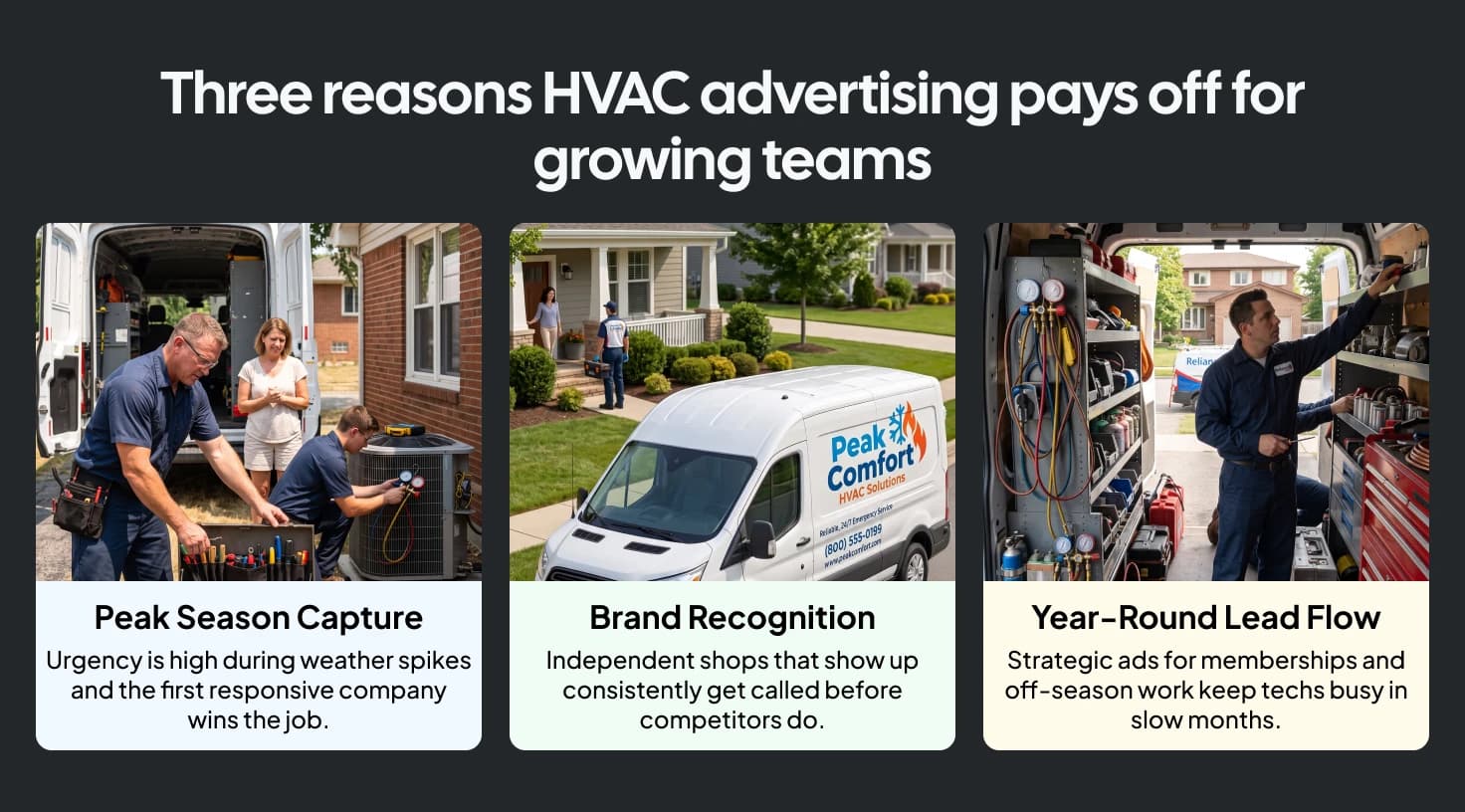
Attracting High-Intent Local Customers During Peak Season: During weather spikes, urgency is high, and loyalty is low. Customers book with the first responsive company, so rapid response is your biggest competitive advantage.
Building Brand Recognition Before Competitors Do: Larger, well-funded HVAC companies are investing heavily in local advertising. Independent shops that build name recognition in their service area early have a real advantage, because homeowners tend to call the company they’ve already seen and heard of when something breaks. Showing up consistently keeps your name top of mind before customers even need you.
Types of HVAC Advertising to Know
To own your local market, you can’t just rely on one trick. You need a mix of quick wins to capture emergency calls and longer-term efforts to build a brand that people trust. Each channel has a different price tag and converts in its own way, so you must keep a close eye on the numbers to know what's actually paying off.
Advertising Channel | Primary Objective | Best For | Operational Focus |
Instant lead capture | Emergency repair calls | Performance-based (Pay-per-lead) | |
Google Search Ads | High-intent targeting | Urgent and planned services | Keyword segmentation, e.g., emergency repair vs replacement |
Social Media Advertising | Brand awareness | Visual, non-urgent offers (e.g., tune-ups) | Community visibility |
Referrals & Online Reviews | Trust and social proof | Long-term growth | Post-job automated review requests |
According to the WordStream 2026 Google Ads Benchmarks, the average CPL for home improvement search ads is $90.92, with an 8.05% average conversion rate.
Building an HVAC Advertising Strategy That Actually Works
To build an advertising strategy that actually moves the needle, you have to treat it like an extension of your field operations. If your marketing creates demand that your dispatch board can't fulfill, you're just wasting money. Here is how to structure your advertising to ensure every dollar translates into a booked job:
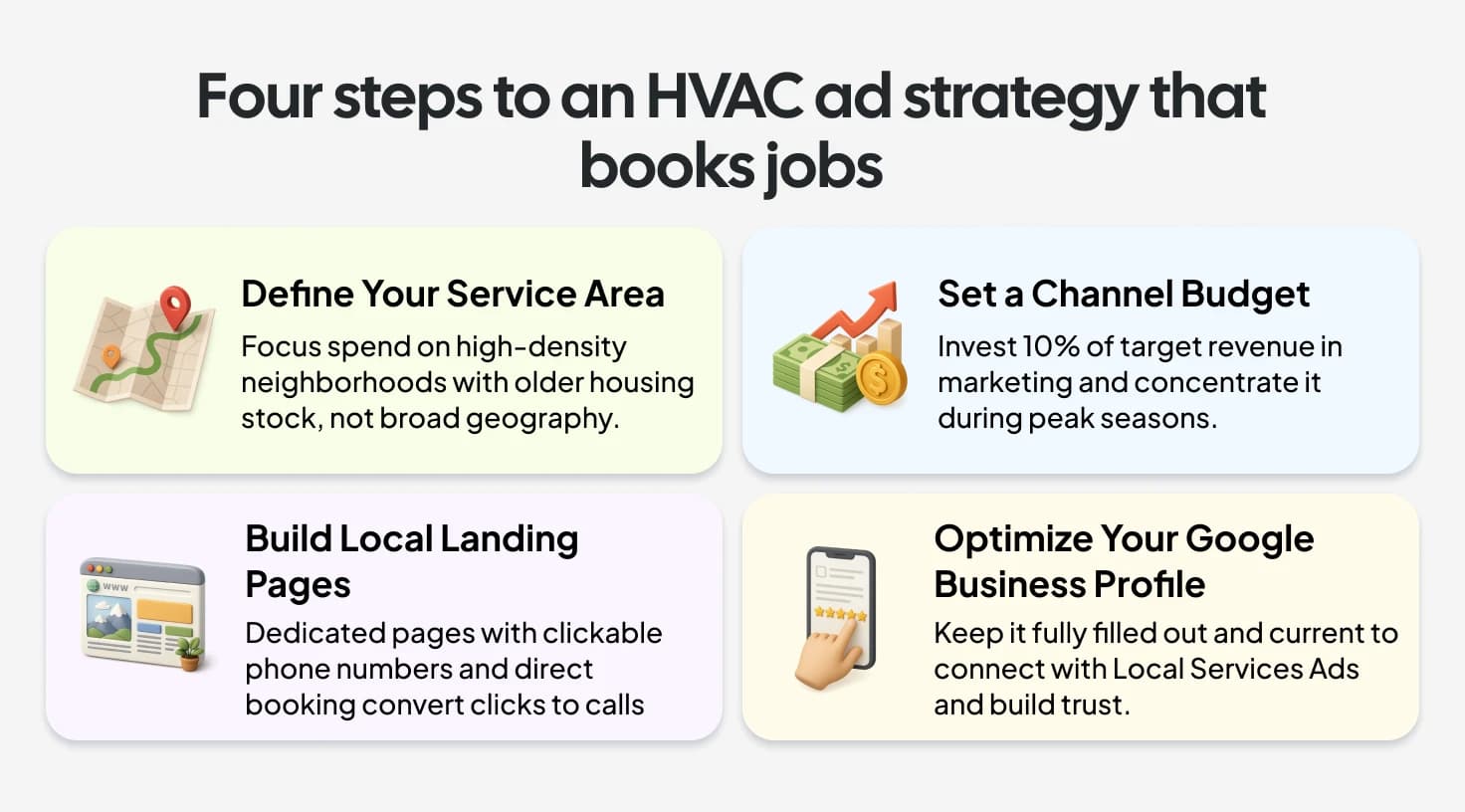
1. Define Your Service Area and Target Customer
Don’t stretch your fleet too thin. Targeting a massive, broad geographic footprint burns fuel and kills your margins with unnecessary travel time. Instead, focus your ad spend on high-density neighborhoods with older housing stock. These areas have a much higher likelihood of needing system replacements and maintenance plans.
2. Set a Realistic Advertising Budget by Channel
Plan to invest 10% of your target revenue into marketing and be smart about it by concentrating the bulk of that spend during your busy seasons. If you're just guessing your budget, you're wasting money. Every dollar you put toward ads needs to have a job to do, tied directly to the revenue you’re trying to hit.
3. Build Landing Pages That Convert Clicks into Calls
Do not send paid traffic to a generic homepage. Create dedicated local landing pages matching search intent. Pages must feature clickable phone numbers, real team photos, and direct booking options to capture leads instantly.
4. Optimize Your Google Business Profile for Local Search
Your Google Business Profile does more than just show your hours; it's what connects you to your Local Services Ads and builds trust before you even pick up the phone. Keep it fresh. Treat it like you treat your trucks: keep it clean, updated, and ready to go. If you're not filling out every field and keeping your service areas accurate, you're making it harder for local customers to choose you.
HVAC Advertising Best Practices
Advertising isn’t a “set it and forget it” expense. If you aren’t adjusting your approach based on what's actually happening on the ground, like a sudden heatwave or a slow week, you're burning cash. Your advertising should act like a real-time dial for your dispatch board.
Target High-Intent Searches During Peak Demand: Don't spread your budget thin. During weather spikes, urgency is everything. Aggressively bid on emergency keywords right before a heatwave hits so your techs are the first ones dispatched to high-ticket repair and replacement jobs.
Run Seasonal Campaigns Before Demand Spikes: Don’t wait for the temperature to spike before you start marketing. Launch your preventative maintenance campaigns weeks early. This fills your schedule during those slow shoulder months, keeping your techs billable when others are sitting idle.
Test Ad Copy and Landing Pages Continuously: Run continuous split tests on ad copy, headlines, and call-to-action buttons. Minor adjustments like adding a 90-minute response time promise can significantly improve conversion rates and lower acquisition costs.
Measuring HVAC Advertising ROI: Which Numbers Actually Matter
The biggest marketing myth in the trades is that rising lead volume equals business success. To protect your profit margins, you must transition from tracking vanity metrics to measuring hard, revenue-based indicators.
Revenue Metric | Definition | Why It Matters |
Cost Per Lead (CPL) | Total ad spend is divided by the number of raw leads generated. | Identifies which platforms are cost-effective and where your budget is being wasted. |
Call-to-Booking Conversion Rate | The percentage of inbound calls and inquiries that convert into a confirmed job. | High-quality leads are only valuable if your team effectively converts them into revenue. |
Revenue Per Ad Source | The exact dollar value invoiced from jobs produced by a specific ad channel. | Serves as your primary profitability metric, allowing you to calculate precise ROI and eliminate guesswork. |
How Workiz Turns HVAC Advertising Into More Booked Jobs
You can spend a fortune on ads, but if you don’t have a system to capture and convert that demand, you're just paying for empty air. Workiz acts as your command center, unifying your marketing, dispatching, and payments into one engine, so no lead slips through the cracks.
Ad and Source Tracking Ties Every Job Back to Its Ad Channel
Stop guessing where your revenue comes from. Workiz Ad & Source Tracking assigns unique tracking numbers and UTM links to every campaign, giving you a clear view of exactly which channels are driving booked jobs, and which are just costing you money.
Genius Marketing Connects Campaign Sends to Revenue
Turn your existing customer data into a revenue stream. Workiz's Genius Marketing uses your customer history to trigger personalized email and SMS campaigns to past clients, recovers cold estimates, and fills your schedule on autopilot.
Genius Answering Captures Leads Before They Call a Competitor
Never let a high-ticket lead go to voicemail. Genius Answering, Workiz's 24/7 AI receptionist, handles after-hours calls, emails, SMSs, lead source inquires, and webforms. It qualifies the prospect, and books the job directly onto the right tech’s schedule, all on its own. By eliminating missed opportunities, you protect your business from losing leads to the competitor down the street.
Reserve With Google and Online Booking Fill Gaps in the Schedule
Give customers a direct line to your dispatch board. By enabling online booking on your website and Google Business Profile, you capture late-night searchers and busy homeowners instantly, turning digital browsers into confirmed service appointments.
Conclusion
Scaling an HVAC business from a local fleet into a regional powerhouse is an operational design challenge rather than a demand generation problem. When physical coordination, scheduling, and tracking methods mature into an automated system, territory expansion becomes highly predictable.
Workiz pulls your dispatch, customer chats, and marketing together in one place, so you're not jumping between a dozen different apps. It makes the whole operation feel like a single, well-oiled machine, ensuring the money you spend on ads actually turns into paid jobs on your techs' schedules.