
Key takeaways
Growth challenges come from dispatch, inventory, and cash flow complexity as teams expand.
Skill-based scheduling and route optimization help technicians complete more jobs with less downtime.
Real-time inventory tracking and low-stock alerts reduce missed jobs and costly supply runs.
Immediate invoicing, automated payments, and job-level profitability tracking improve cash flow.
Growth in a garage door business doesn't fail because of demand. It fails because operations don't evolve at the same speed. Once you move from a small crew to multiple technicians, the system that once worked fine starts breaking quietly: a spring job gets assigned to the wrong tech, a van runs out of torsion springs mid-week, an invoice sits unsent for three days, and a second crew sits underutilized while the first is overbooked.
Scaling is not about adding more jobs. It's about building structures that absorb volume without creating chaos.

Why scaling a garage door business creates new operational pressure
As garage door companies grow, what used to be manageable becomes a coordination problem. Small inefficiencies that were invisible at 2–3 technicians multiply into real revenue leaks at 10+ techs, and most of them show up first in dispatch, inventory, and cash flow.
The U.S. garage door installation industry is growing at a CAGR of 6.1% over the past five years, reaching an estimated $459.3 million in 2026. But capturing that growth requires operational systems that can keep pace.
Growing teams start feeling pressure in these three core areas:
More techs mean more dispatch complexity: With 2–3 technicians, dispatching is intuitive. With 5–15, it becomes a coordination problem. Every job has variables: skill level, location, urgency, parts availability, and customer expectations. Without structured dispatch logic, you lose efficiency fast.
Inventory gaps start costing jobs: At scale, inventory errors multiply. A missing torsion spring or wrong remote isn't a small delay; it's a lost appointment window and a hit to reputation. The bigger the team, the more invisible inventory drift becomes.
Cash flow gets harder to predict and control: More jobs should mean more revenue, but delayed invoicing, inconsistent pricing, and untracked job costs distort cash flow. You're busy but not always profitable or liquid.
How to build a dispatching system that keeps techs moving
An effective dispatch system ensures the right tech gets the right job at the right time. As teams scale, dispatchers need tools to automate assignments, optimize routes, and absorb changes.
Below is a structured dispatch model with typical outcomes seen by top teams (and Workiz users):
Dispatch strategy | Implementation (Workiz Tools) | Outcomes (KPIs) |
Skill-based routing | Tag each tech's expertise and use Genius Scheduling to auto-assign by skill (e.g., opener vs spring repair). | Higher first-time fix rate; right tech closes bigger jobs and lifts average ticket size. |
Geographic clustering | Use Service Areas, Location Tracking, and Genius Scheduling to group and route jobs by zone/neighborhood. | Reduced drive time and more jobs completed per day. |
Priority scheduling | Mark urgent jobs as high priority. Genius Scheduling helps find the earliest available slots while considering skills and location. | Faster emergency response and reduced customer backlog. |
Live reassignment & updates | Use real-time Location Tracking (GPS), On My Way notifications with ETA, and drag-and-drop reassignment in the schedule. | Dispatchers handle more jobs with less idle time; faster response to changes and hot leads. |
Schedule visibility & gaps | View all technicians' schedules on a single, real-time centralized calendar to instantly spot open time slots and book jobs exactly where capacity exists. | Reduces scheduling friction, cuts customer call-handling time, and ensures a balanced workload across multiple crews. |
Skill-based fleet dispatching | Use Workiz Schedule and dispatching tools to filter the centralized calendar by technician skills/expertise, team, and service areas to assign the right job to the right tech. | Optimizes daily crew capacity, reduces scheduling human errors, and ensures the best-suited technician is selected for every job. |
Managing inventory across multiple crews and locations
Inventory chaos is silent until it becomes expensive. At scale, you don't lose track of big items; you lose track of small, frequently used components that silently erode margins.
1. Track parts in real time across every location
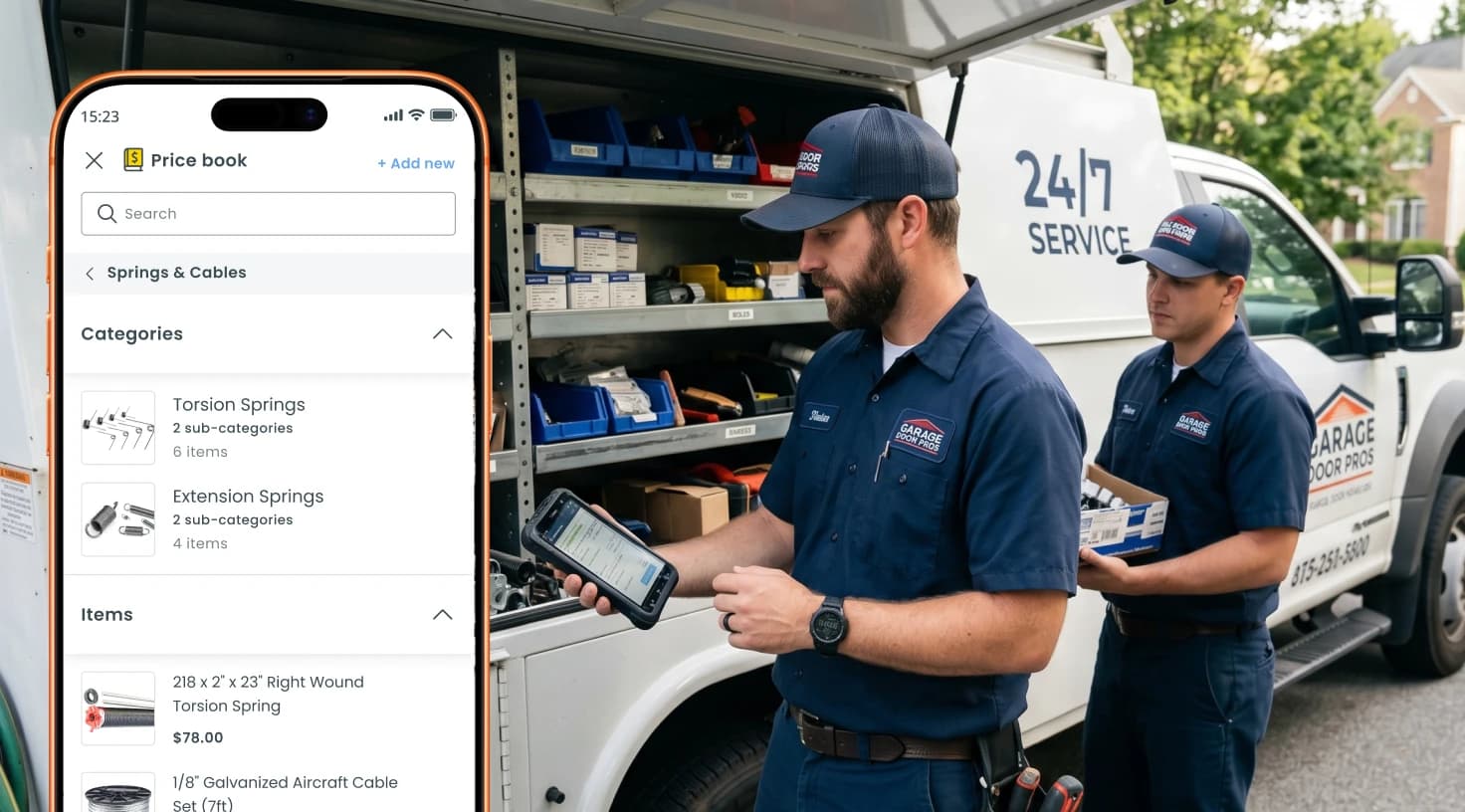
Every van becomes a mobile warehouse. Without real-time tracking, you're duplicating stock unnecessarily or sending techs to jobs under-equipped.
2. Set low-stock alerts before a job goes sideways
Reorder thresholds should be based on job volume, not guesswork. Springs, rollers, and openers should never hit zero mid-week.
3. Reduce emergency purchases with better visibility
Emergency supply runs cost more than parts. They cost time, technician availability, and customer trust.
Key inventory controls:
Standardized van stocking lists
Barcode or digital check-in/out system
Weekly reconciliation audits
Job-linked parts consumption tracking
How to strengthen cash flow as job volume grows
Scaling breaks cash flow when operations outpace financial discipline. Revenue becomes inconsistent not because demand drops, but because collection timing and job costing are unclear.
In 2025, over half of U.S. small businesses were owed money from unpaid invoices averaging $17,500 per business in outstanding payments and businesses with overdue invoices are more likely to report cash flow struggles that limit growth and hiring.
Invoice on the job, not back at the office: Every delay between service completion and invoicing increases the probability of delayed payment. The most stable operators invoice immediately in the field.
Track profitability by job type: Not all jobs are equal. Installations, repairs, and emergency calls have different margins. Track how much cash and labor each job consumes and adjust pricing for future bids to target the highest-grossing opportunities.
Cut payment delays with integrated collections: Manual follow-ups don't scale. Automated reminders, payment links, and on-site card collection significantly reduce AR (Accounts Receivable) aging.
Closing more estimates before the tech leaves the driveway
The highest-performing garage door companies don't rely on office follow-ups, they close on-site. The average conversion rate for home service search ads in 2025 sat at 7.33% industry-wide, meaning on-site closing discipline is one of the most direct levers for improving that number.
Equip your field technicians with mobile tools to build, present, and approve estimates while standing in the customer's driveway to increase conversion rates and lift your average ticket size.
Present tiered options on every high-ticket job
Customers respond better to structured choice than single-price quotes. Technicians should provide tiered sales proposals featuring three distinct paths:
Good: basic repair option
Better: upgraded parts + warranty
Best: full system replacement
This framing increases conversion without increasing pressure.
Offer financing to сlose system replacements on the spot
Large-ticket hesitation disappears when financing is available immediately. Technicians who can present financing options in real time consistently close more full replacements.
How to standardize operations as your team grows
Scaling without standardization creates different businesses within one business. Each technician develops their own way of doing things, which destroys consistency.
1. Build repeatable workflows for every job type
Growth brings variation in how technicians handle the same jobs, leading to missed steps, inconsistent outcomes, and quality gaps that directly impact customer experience and revenue stability. To eliminate this, define structured workflows for every core service type, like installations, repairs, and maintenance.
2. Hold techs accountable with performance data
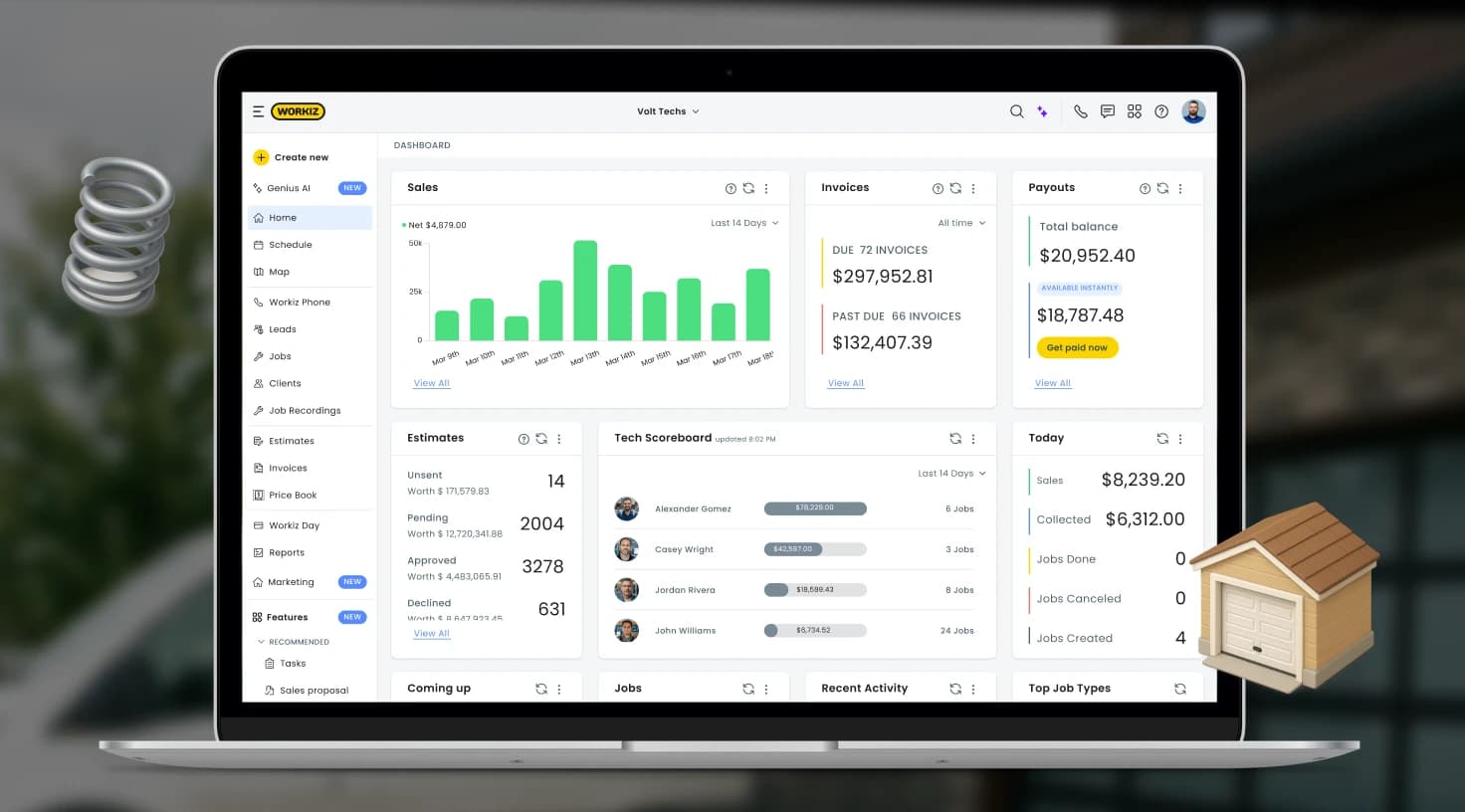
Once workflows are standardized, performance must be measured consistently to ensure execution quality doesn't drift as the team grows. Tracking technician-level data helps identify top performers, uncover inefficiencies, and improve coaching decisions using real operational signals instead of assumptions.
3. Onboard new hires faster with consistent processes
Hiring more technicians only drives growth when onboarding is structured enough to make them productive quickly and consistently across all job types. Without standardized onboarding, new hires learn differently from each senior technician, creating inconsistent habits and longer ramp-up cycles.
Standardization powered by Workiz Genius AI
Operational area | Standardization focus | Outcomes |
Job intake | Structured lead capture | 24/7 AI call answering; missed calls captured instantly |
Diagnosis | Guided field execution | Standard mobile workflows reduce repeat visits |
Pricing | Consistent quoting | Tiered estimates improve quote speed and consistency |
Optimized dispatch flow | AI-driven scheduling improves job allocation efficiency | |
Job execution | Standard field delivery | Mobile checklists ensure consistent job completion |
Completion | Instant closeout & payment | Same-day invoicing enabled through mobile workflows |
Follow-up | Automated retention | Automated campaigns improve repeat booking rates |
Performance tracking | Technician accountability | Call Insights improves visibility into customer interactions |
Onboarding | Fast technician ramp-up | Onboarding in under 2 weeks with guided workflows |
How Workiz helps garage door businesses scale without the chaos
At scale, Workiz becomes the operational backbone that connects dispatch, technicians, inventory, communication, and payments into one operational flow. Instead of juggling multiple tools, everything runs in one place.
The broader field service management software market is projected to grow from $5.10 billion in 2025 to $9.17 billion by 2030, reflecting how urgently service businesses across every trade are investing in systems to manage scale.
Dispatch smarter with AI-suggested scheduling
Instead of manually coordinating every job, Workiz's Genius Scheduling suggests optimal job time slots based on technician availability, location, and existing schedule, reducing travel time and keeping daily capacity full.
Track parts across vans and warehouses in real time
Workiz centralizes inventory across vans and warehouses in real time, giving owners full visibility into parts availability and preventing stock mismatches before they impact jobs.
Get paid faster with integrated payments and financing
Built-in payments and financing reduce collection delays by enabling instant invoicing, on-site payment capture, and financing approvals directly from the field.
Never miss a lead with AI Answering
Workiz's Genius Answering, Jessica, handles calls, texts, and emails 24/7, qualifies leads, and ensures every inquiry becomes a scheduled opportunity without manual follow-up.
By integrating these tools, Workiz turns the chaotic experience of scaling into a frictionless process. Scheduling, parts, payments, and even customer intake are unified in one platform, removing the manual friction that usually grows with more jobs.
The real impact of systemized operations
Teams using Workiz typically see:
An average of 22–23% revenue lift
Winning 3X more jobs
Onboarding in under 2 weeks
20+ hours of administrative waste reclaimed per week
In effect, each of the challenges of scaling becomes an opportunity for efficiency and growth when handled with the right software.
Conclusion
Scaling a garage door business is more of an operational design problem than a sales issue. Dispatching, inventory control, and cash flow management must evolve from informal habits into structured systems.
The companies that scale cleanly don't work harder. They rely on tighter systems that remove uncertainty from every layer of operations, wherein:
Dispatch becomes predictable
Inventory becomes visible
Cash flow becomes timed and controlled
Technicians become accountable through data
Once these systems are in place, growth stops being chaotic and starts becoming repeatable.